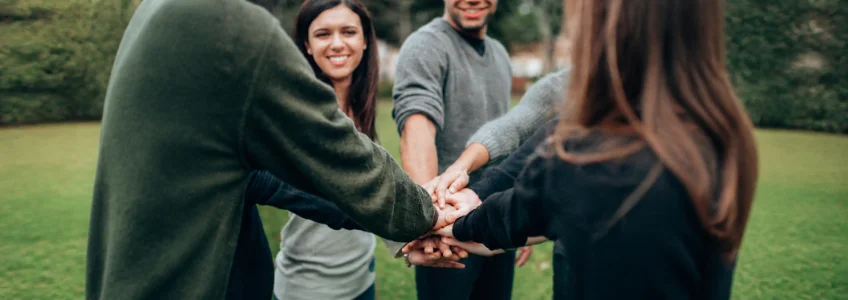
Every August 12, International Youth Day invites us to focus on the younger generations and their ability to actively participate in shaping the present and the future. In the face of challenges such as inequality, climate change, a lack of educational opportunities, and the need to build more inclusive societies, young people are at the forefront of social transformation.
Here at FUNIBER’s Social Action department, we join in marking this occasion to highlight that research, volunteerism, and art are all paths that share a common starting point: the will to act and participate.
The stories of Paula Buenaño, Álex Elvira Alfonso, Maria de Lourdes Pedro, and Élvia Bento illustrate precisely this diversity of ways to participate. From a research project on environmental pollution to coordinating university volunteer activities or using photography to shed light on social issues, their experiences reflect different ways in which young people can contribute to their communities.
Research to Understand and Transform
Paula Buenaño embodies the potential of youth when curiosity turns into research. At age 17, she won second place in the 2025–2026 edition of the FUNIBER Investiga International Pre-University Award, thanks to a project focused on the effects of plastic nanoparticles on aquatic plants.
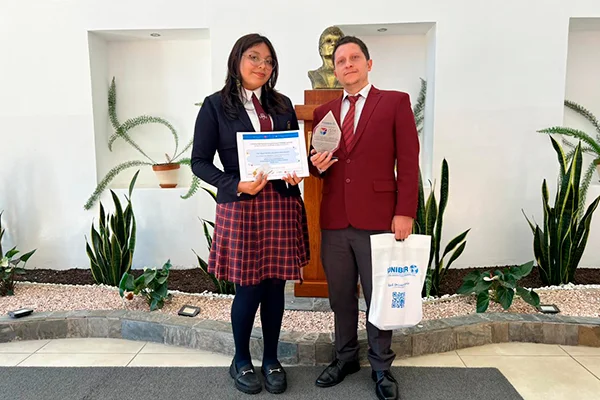
Her research addresses a specific environmental issue and explores phytoremediation alternatives using native plants. Beyond the recognition she received, her experience shows how young people can approach complex problems, study them, and propose possible solutions.
Their project stems from an environmental reality but points to a broader issue: the capacity of knowledge to become a tool for transformation.
Paula’s experience also highlights the importance of creating spaces where students can conduct research from the early stages of their education. When a young person finds the opportunity to develop an interest and turn it into a project, education ceases to be merely the acquisition of knowledge and becomes a form of social participation as well.
Volunteering as Learning and Commitment
Social transformation can also begin through direct participation in the community. This is the case of Álex Elvira Alfonso, a student at the European University of the Atlantic (UNEATLANTICO), who helps coordinate the volunteer program among university students.
In this role, Álex provides updates on activities, manages communication, answers questions, and encourages other students to participate. Although he hasn’t been directly involved in every initiative, his role has given him firsthand insight into the impact these efforts generate.
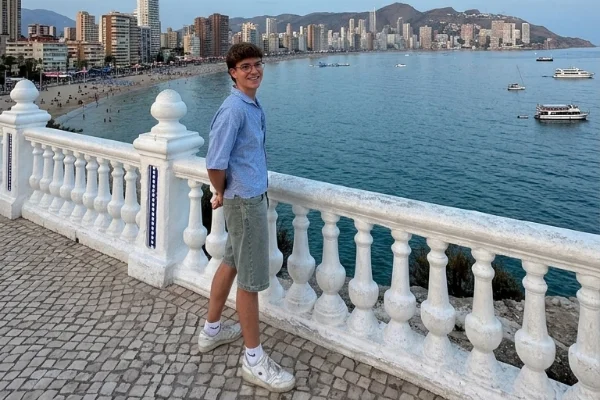
For him, volunteering represents much more than just an experience that complements his studies. It has allowed him to develop organizational, communication, responsibility, and coordination skills, while also enabling him to observe how his peers discover new realities and grow personally.
His experience also highlights a significant challenge: often, young people aren’t lacking interest in participating, but rather information and concrete opportunities.
“Change often begins with people who decide to get involved,” notes Álex.
His reflection sums up one of the keys to youth participation: creating opportunities and facilitating that first step can be decisive in turning interest into action.
When Art Becomes a Form of Social Action
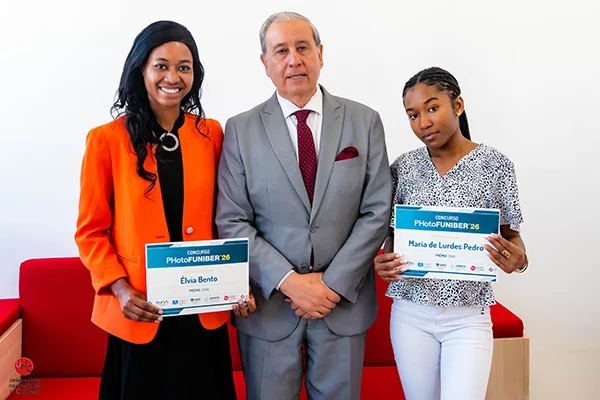
Photography offers a third way to participate in the transformation of society. The experiences of Maria de Lourdes Pedro and Élvia Bento, students at the Universidade Internacional do Cuanza and winners of the UNIC Special Prize at PHotoFUNIBER’26, show how an image can become a tool for observing, questioning, and raising awareness.
Maria de Lourdes found the image she submitted to the contest during a photography walk through various municipalities in Luanda. On a street in the Catambor neighborhood, she observed walls weathered by time and rain. The appearance of a group of children running transformed the scene and allowed her to capture an image that brings together the hardships of the environment and the vitality of those who live there.
Her photograph also led her to reflect on the way Africa is portrayed. In contrast to images that may reduce the continent to poverty or its shortcomings, she advocates for the need to show other perspectives and recognize the potential, creativity, and capabilities of its communities.
For her, the value of a photograph lies not solely in the camera or the technique.
“What brings a photograph to life is not the camera; it’s the photographer’s gaze.”
Élvia Bento, for her part, found the image she submitted to the contest during a trip to Benguela, in the municipality of Catumbela. The scene led her to reflect on the situation of children who should be included in educational programs but who, instead, found themselves in other circumstances. Her goal was to prompt reflection.
Photography, she explains, can help more people become aware of certain situations and view them from a different perspective. If she could expand her project, she would seek to identify other similar realities and promote greater community involvement to help children gain access to opportunities for training, education, art, and sports.
The Responsibility of Communication
Maria de Lourdes’s and Élvia’s experiences also highlight a particularly relevant aspect of digital society: the responsibility involved in representing and sharing images of other people.
Both reflect on the need to protect image rights and respect privacy, especially when it comes to minors. For Élvia, one of the main challenges of her project was explaining to the children’s guardians how the photograph would be used and what its purpose was.
This experience reinforced her conviction that young people should think carefully before posting images.
This issue is particularly relevant in an age when a photograph or video can reach thousands of people in a matter of seconds. Communication also involves taking responsibility for what is shown and for how others are portrayed.
In this way, art is not limited to producing images: it can also educate the viewer’s perspective, challenge stereotypes, and promote a more conscious representation of reality.
Four experiences, one idea: participation
Although their projects are different, they share the same underlying logic. Paula conducts research to understand issues and find solutions. Álex organizes and mobilizes other young people to get involved. Maria de Lourdes uses photography to challenge representations of her reality. Élvia uses images to shed light on a problem and highlight the need for action.
Research, volunteer work, and art thus become different expressions of the same commitment: not to remain indifferent to what is happening around us.
This perspective also broadens the concept of social education. Education does not mean merely transmitting academic content. It means developing the ability to interpret the world, coexist with others, take on responsibilities, and participate in building solutions.
Education to Expand the Possibilities for Transformation
For this potential to develop, it is essential that young people have access to training opportunities and spaces where they can put their knowledge and skills into practice.
From Knowledge to Action
These four experiences remind us that social transformation does not follow a single formula. It can begin with a scientific question. It can arise while organizing a volunteer activity. It can emerge behind a camera lens.
It can start in a classroom, at a university, in a neighborhood, or during a conversation.
What matters most is that there is the possibility of turning a concern into action.
Researching, serving, creating, and educating are different ways to bring about change. And when these possibilities meet educational opportunities, young people can turn their knowledge, creativity, and commitment into real impact for their communities.
Creating opportunities for young people to study, research, participate, and develop their skills also means investing in their potential to make an impact. Because when education is combined with commitment, knowledge can become action, and action can become social transformation.