
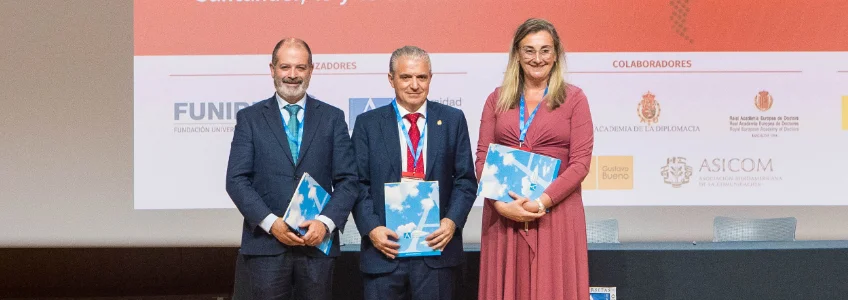
The Iberoamerican University Foundation (FUNIBER), the Universidad Europea del Atlántico (European University of the Atlantic, UNEATLANTICO), and the China Chair Foundation signed the so-called “Santander Agreement,” a general cooperation agreement signed within the framework of the 8th Ibero-American and Iberophony Forum, held on October 15th and 16th at UNEATLANTICO’s headquarters in Santander (Spain). The agreement represents a strategic step toward strengthening institutional, academic, and cultural relations between China and the multinational community of Spanish- and Portuguese-speaking countries, known as the Pan-Iberian or Iberophone Space.
Representing the three institutions were the president of FUNIBER, Dr. Santos Gracia; the rector of UNEATLANTICO, Dr. Rubén Calderón Iglesias; and the president of the China Chair Foundation, Marta Montoro. The agreement reflects a shared commitment to expanding opportunities for collaboration between China and Iberian-speaking countries through initiatives that bring together higher education, research, culture, and international relations.
A Framework for Academic and Institutional Cooperation
Among the main initiatives outlined in the agreement is the creation of an Iberophony Section within the China Chair Foundation, which will receive support and guidance from the FUNIBER Chair of Iberoamerican and Iberophonic Studies. The latter is an interdisciplinary, interuniversity, intercontinental, and bilingual academic space comprising six universities from FUNIBER’s International University Network, with a presence in Europe, the Americas, and Africa, including UNEATLANTICO.
The agreement also provides for the implementation of programs, activities, and projects of mutual interest, including conferences and seminars in the fields of education, teaching, research, and the dissemination of knowledge in China and in Iberian-speaking countries. These initiatives aim to promote academic and cultural exchange, as well as to establish new avenues for collaboration between universities and other organizations linked to both communities.
The agreement also incorporates some of the proposals discussed during the 8th Forum, which brought together experts and institutional representatives from countries in the Americas, Africa, and Europe, as well as from China and other nations linked to the Ibero-American and Iberophone spaces.
 From left to right, Dr. Rubén Calderón, president of UNEATLANTICO; Dr. Santos Gracia, director of FUNIBER; and Marta Montoro, president of the China Chair Foundation, during the signing of the agreement as part of the 8th Ibero-American and Iberophony Forum.


Languages as Tools for International Cooperation
In an international context that calls for new avenues of dialogue and understanding, multilingualism takes on a strategic dimension for relations between China and the Iberophone space. As Marta Montoro, executive president of the China Chair Foundation, points out, “Spanish, Portuguese, and Chinese are three strategic languages for the future of international relations.” Their joint projection can foster academic cooperation, intercultural dialogue, and the development of more diverse and inclusive relationships.
In this regard, the FUNIBER Chair of Iberoamerican and Iberophonic Studies proposed during the 8th Forum that Chinese authorities consider adopting Spanish as a strategic instrument for their foreign policy. The initiative highlights the importance of diversifying international communication channels and reducing the communicative, material, and symbolic dependencies associated with the dominance of English, thereby expanding the possibilities for dialogue among countries and cultures.
Along this line, the Santander Agreement represents an opportunity to translate this vision into concrete cooperation initiatives, in which academic exchange and the promotion of Spanish, Portuguese, and Chinese will help strengthen relations between China and Iberophone space.