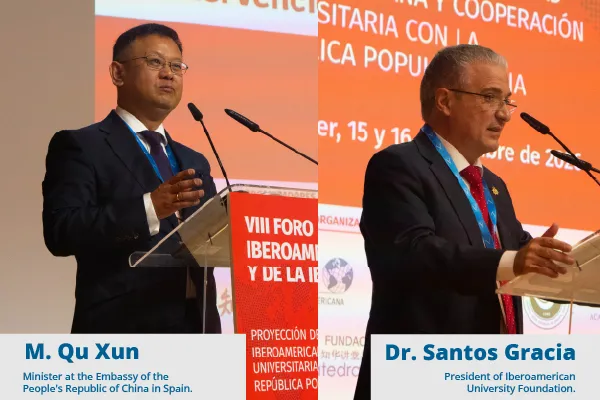
The recent 8th Ibero-American and Iberophony Forum highlighted the outstanding harmony and convergence between the remarks made by the president of the Iberoamerican University Foundation (FUNIBER), Dr. Santos Gracia Villar, and the Minister of the Embassy of the People’s Republic of China in Spain, Qu Xun, in highlighting the geopolitical potential that the Iberian World and the People’s Republic of China represent together.
This convergence stems from the recognition of the scope of the Pan-Iberian or Iberophone Space, which comprises 30 countries and nearly 900 million people worldwide. This field serves as a platform for cultural, linguistic, and institutional collaboration, with the capacity to expand its international relations. In this regard, Dr. Santos Gracia emphasized the need to promote strategic cooperation between China and all Spanish- and Portuguese-speaking countries in the current geopolitical context. He also pointed out that China and the Iberian-speaking nations, taken together, comprise a region of nearly 2.5 billion people, about one-third of the world’s population.
This demographic aspect presents a far-reaching opportunity to foster cooperative relationships and strengthen ties between national and multinational communities, which—drawing on their respective cultural and linguistic traditions—can develop new avenues for understanding.
A Shared Vision for International Cooperation
From the perspective of Chinese diplomacy as expressed by Qu Xun, the importance of strengthening relations among China, Europe, and Ibero-America through mutual respect, intercultural dialogue, and cooperation was emphasized, with the aim of moving toward the construction of a community with a shared future—a strategic objective of Chinese foreign policy.
The senior diplomatic official also noted that the Spanish- and Portuguese-speaking world constitutes a vast space for the exchange between civilizations, spanning Europe, the Americas, Africa, and Asia, whose historical and cultural heritage serves as a valuable link between different peoples and societies. In this regard, he highlighted the complementary nature of Hispanic and Chinese civilizations.
In this context, he also highlighted the strategic potential of the ties between China and Ibero-America—a relationship that connects nearly 2.5 billion people, approximately one-third of the world’s population—and offers significant opportunities for cooperation in the demographic, cultural, and economic spheres.
Academic and Cultural Dialogue as a Strategic Tool
Thus, the views expressed by both speakers converged on numerous objective points and on the need to recognize the potential of relations between China and the Iberian world as a whole, as well as to promote mechanisms for cooperation that would make it possible to leverage on the opportunities offered by this convergence.
The interest generated by these presentations was also reflected in the high level of remote participation during the Forum, which was viewed online by more than 3,000 attendees and included the participation of 17 Chinese universities.
The convergence of perspectives between FUNIBER and the Chinese diplomatic mission thus highlighted the existence of a shared vision regarding the opportunities offered by cooperation between the Iberian world and China. A perspective that views intercultural dialogue, university cooperation, and recognition of the international dimension of languages as ways to strengthen the ties between these two spheres.