
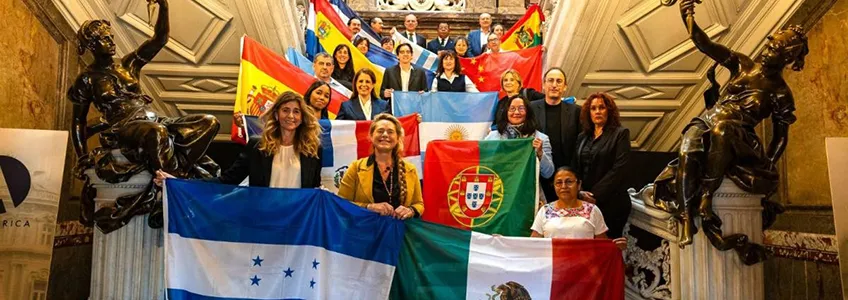
The FUNIBER Chair of Iberoamerican and Iberophonic Studies participated in the 3rd Miguel de la Quadra-Salcedo Expeditionaries Summit, held under the theme “Universal Iberophony: The Voices That Unite Us, from Ibero-America to the World.” The event took place on November 4th and 5th at Casa de América, in Madrid, as part of the side events for the 30th Ibero-American Summit of Heads of State and Government, and brought together representatives from the diplomatic, institutional, academic, and business communities to discuss new opportunities for cooperation among the countries and peoples linked by the Spanish and Portuguese languages.
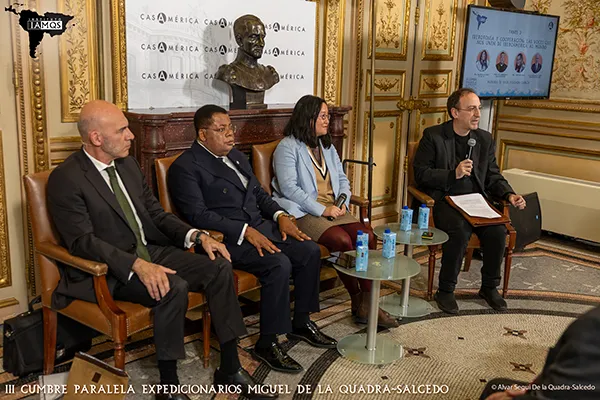
At this event, which was attended by the president of the Iberoamerican University Foundation (FUNIBER), Dr. Santos Gracia Villar, and the FUNIBER Chair, Dr. F. Álvaro Durántez, took place during the third panel of the conference, titled “Iberophony and Cooperation: The Voices That Unite Us, From Ibero-America to the World,” a forum dedicated to analyzing the Iberophone community’s ability to forge international relationships, strengthen ties between different regions, and promote joint initiatives in the cultural, educational, scientific, and institutional spheres.
The purpose of this conference was to present the findings of the expedition community and to open new avenues for collaboration with universities, institutions, and organizations involved in knowledge, culture, and international cooperation. The meeting also addressed initiatives aimed at linking the experience accumulated by different generations of expedition members with new projects and opportunities for future generations.
Miguel de la Quadra-Salcedo: Exploring to Learn and Connect Cultures
The 3rd Summit pays tribute to the legacy of Miguel de la Quadra-Salcedo, a Spanish journalist, reporter, Olympic athlete, and explorer, whose career was closely linked to cultural outreach and the education of young people through hands-on experience. His main educational legacy was the Aventura 92 program, later known as Ruta Quetzal, an initiative designed to introduce new generations to the history, geography, and cultural diversity of Ibero-America through international expeditions.
Over the course of its 31 editions, held between 1979 and 2016, more than 10,000 young people from nearly 60 countries participated in this educational experience. The trips combined academic, scientific, cultural, and athletic activities with opportunities for participants from different backgrounds to interact, turning exploration into a method for learning, exchange, and mutual understanding.
Ten years after the death of Miguel de la Quadra-Salcedo, his expeditionary community seeks to carry on this philosophy and extend it to new areas of collaboration. In this context, the Miguel de la Quadra-Salcedo Iberoamerican Institute was presented, conceived as a forward-looking initiative linked to his legacy, as well as the Miguel de la Quadra-Salcedo Living Atlas of Expedition Members, presented by Sol de la Quadra-Salcedo, president of the MQS-RVS Expedition Members Association.
This atlas serves as a tool for identifying and connecting the knowledge, professional skills, experiences, projects, and opportunities for cooperation of those who have participated in the expeditions. In this way, the expedition community aims to transform a shared journey into an active network of intergenerational collaboration, capable of fostering new educational, scientific, and cultural initiatives.
Three Forums for Dialogue on Cooperation, Knowledge, and Iberophony
The program began with opening remarks by León de la Torre, director general of Casa de América, and a virtual address by Sara Aagesen, third vice president and minister for Ecological Transition and the Demographic Challenge of the Government of Spain, who participated as a member of the 1993 expedition, known as the Las Hibueras expedition. Subsequently, the expedition team presented its main conclusions, and institutional initiatives related to the continuation of this project were outlined.
The event was organized around three panel discussions. The first panel, “Business, Talent, and Cooperation: The Driving Force Behind Ibero-America,” brought together José Luis Bonet, president of the Spanish Chamber of Commerce; Lorenzo Amor, vice president of the Spanish Confederation of Business Organizations (CEOE); and Elisa Aracil, vice rector for Strategy, Internationalization, and Academic Planning at Universidad Pontificia Comillas. Moderated by Jesús Sainz, the discussion explored ways to turn talent and accumulated experience into business opportunities and cooperation projects.
The second panel, “From Knowledge to the Future: Exploring, Learning, and Sharing Ibero-America,” focused on the educational, scientific, and cultural aspects of the expeditions. Participants included Mónica García, representative of the Organization of Ibero-American States (OEI); Rosario Cristóbal, vice rector for International Relations, Cooperation, and Volunteering at the Universidad Complutense de Madrid; María Paz Martín, research professor at the Spanish National Research Council (CSIC); and Nicolás Canosa, from the International Youth Organization for Ibero-America (OIJ). The panel was moderated by Sol de la Quadra-Salcedo and provided an opportunity to reflect on exploration as a methodology for researching, learning, promoting cultural heritage, and passing on knowledge to future generations.
Iberophony and Cooperation: The Voices That Connect Ibero-America to the World
The third panel featured the director of the FUNIBER Chair, Dr. F. Álvaro Durántez, who brought to this discussion the academic and geopolitical perspective of the Pan-Iberian or Iberophone Space—a multinational and intercontinental sphere comprising some thirty countries and nearly 900 million people linked by the Spanish and Portuguese languages across all continents. His remarks explored the international dimension of iberophony and its potential as a platform for bringing together Ibero-American and Portuguese-speaking communities with other countries and regions around the world, such as the People’s Republic of China.
Also participating were Fernando Ignacio Ondo, a member of the Equatorial Guinean Academy of the Spanish Language and president of the International Center for Graduate Studies of Equatorial Guinea (CIPGE); and Cristina Zhou, director of the Confucius Institute in Coimbra. The session was moderated by Jesús Folgado García, director of the Pantoja Observatory at Universidad Pontificia Comillas and a member of the Portuguese Academy of History.
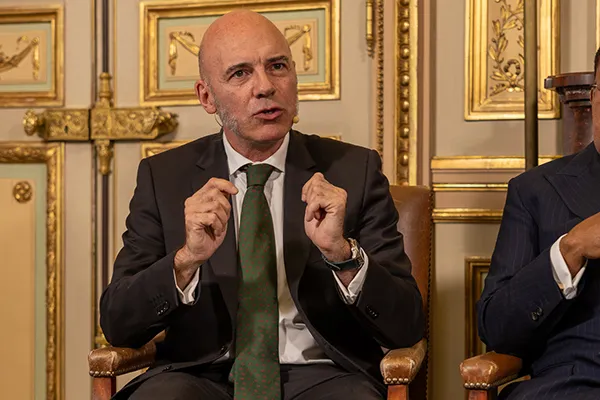
 Remarks by Dr. F. Álvaro Durántez Prados, director of the FUNIBER Chair, during the 3rd panel titled “Iberophony and Cooperation: The Voices That Unite Us, From Ibero-America to the World.”
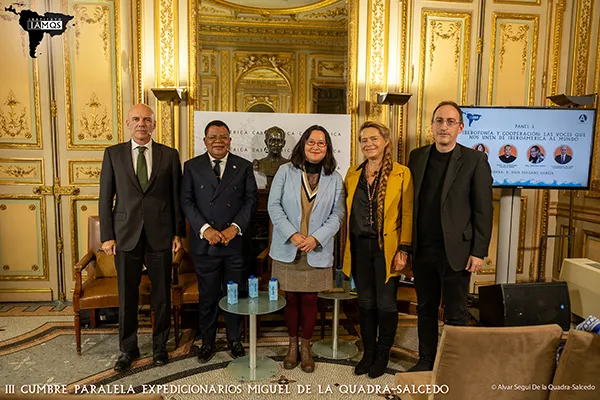
Beyond their linguistic proximity and historical ties, this region offers an opportunity to foster horizontal and triangular cooperation, promote academic and scientific exchange, and broaden the international dialogue among its countries and societies.
In this regard, the coordination of the Pan-Iberian Space makes it possible to translate linguistic and cultural affinities into concrete cooperation initiatives, thereby fostering the establishment of institutional partnerships, the exchange of experiences, and the development of joint projects. This perspective broadens the opportunities for international engagement for Iberophone countries and helps strengthen their presence in various forums for multilateral dialogue and cooperation.
During this event, important statements were made regarding the process of establishing the Pan-Iberian Space.
Through the FUNIBER Chair’s participation in the Miguel de la Quadra-Salcedo Expeditionaries Summit, this academic institution reaffirms its commitment to the international outreach of the Pan-Iberian Space and to strengthening the ties between education, culture, knowledge, and diplomacy. Given its interdisciplinary, interuniversity, and intercontinental nature, it promotes the study of Ibero-American and Iberophone realities, as well as the development of initiatives that foster dialogue and cooperation among Spanish- and Portuguese-speaking nations on all continents.