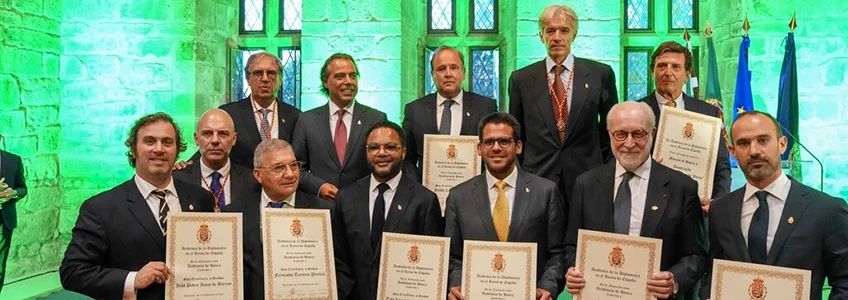
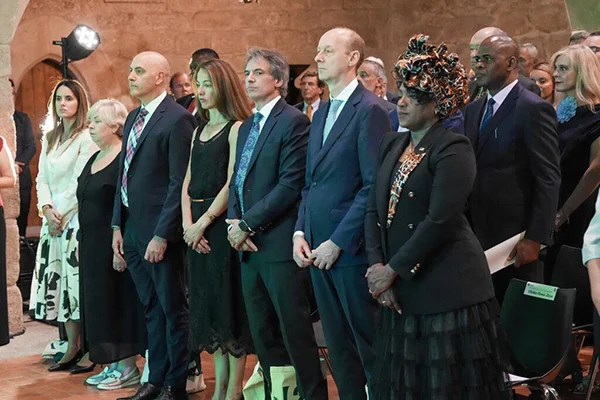
On September 10th, the Palace of the Dukes of Braganza, in the historic Portuguese city of Guimarães, hosted the first formal induction ceremony for new members of the Academy of Diplomacy in Portugal. The event brought together diplomatic representatives and prominent figures from the business, academic, journalistic, institutional, and professional sectors.
The ceremony was attended by Santiago Velo de Antelo, executive president of the Academy of Diplomacy; José Carlos Ruiz-Berdejo, vice president of the Academy of Diplomacy; Jorge Antas de Barros, head of the Academy of Diplomacy’s delegation in Portugal; Ricardo Araújo, mayor of Guimarães, as well as representatives from the embassies of Angola, Argentina, Australia, Belgium, the Philippines, Hungary, Israel, Lithuania, Mexico, Mozambique, Ukraine, and Uruguay. The Iberoamerican University Foundation (FUNIBER) was represented by the director of FUNIBER in Portugal, Prof. Nancy E. Ferreira Gomes, and by the Director of Institutional Relations, Dr. F. Álvaro Durántez Prados.
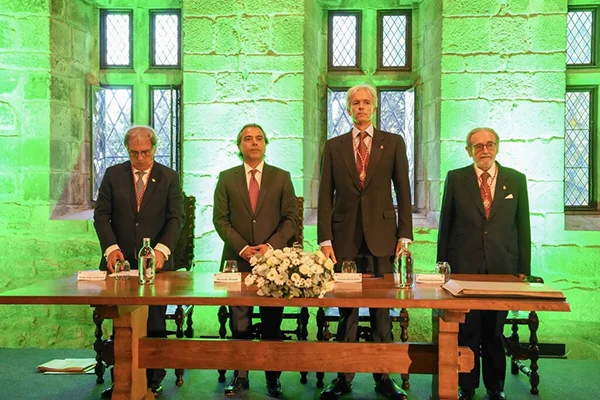
Guimarães as a Venue for Diplomatic Dialogue
The session centered on the induction of thirteen new members of the Academy, who come from various sectors of public and professional life. The ceremony highlighted the institution’s commitment to promoting dialogue between diplomacy and other fields related to international relations, culture, business, academia, and civil society.
The choice of Guimarães—known as the cradle of the Portuguese nation—as the venue for this session placed the Academy’s activities in a city of special historical and cultural significance, while also fostering closer ties among diplomatic representatives, local authorities, and Portuguese institutions.
With a branch office established in Cascais since 2023, the Academy’s presence in Portugal expands its scope of activities and institutional relationships. In this regard, holding this inauguration ceremony in Guimarães provided a symbolic setting of great conceptual and historical significance.
Iberophony and Pan-Iberism in Diplomatic Dialogue
During his remarks, Santiago Velo de Antelo spoke briefly about FUNIBER’s presence and activities and highlighted the geopolitical, educational, and cultural initiative promoted and developed by the Foundation around the concepts of Paniberism and Iberophony. In this context, he referred to the concept of a multinational space that connects Spanish- and Portuguese-speaking countries, with an intercontinental perspective and no geographical exceptions.
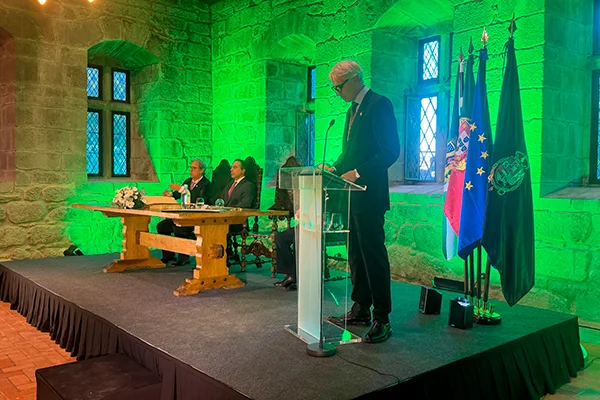
The president of the Academy also acknowledged the role of Dr. F. Álvaro Durántez Prados, a pioneer and champion of contemporary Pan-Iberism, in the dissemination and development of these proposals, which are aimed at strengthening relations among Iberian-speaking countries through cooperation, mutual understanding, and the forging of ties between different regions.
The mention of these concepts during a diplomatic meeting in a setting of particular historical significance highlights their significance as a proposal for international cooperation and as a framework for addressing relations between the Spanish-speaking and Portuguese-speaking communities from a broad perspective. One of the main areas where this line of work is carried out is the FUNIBER Chair of Iberoamerican and Iberophonic Studies.
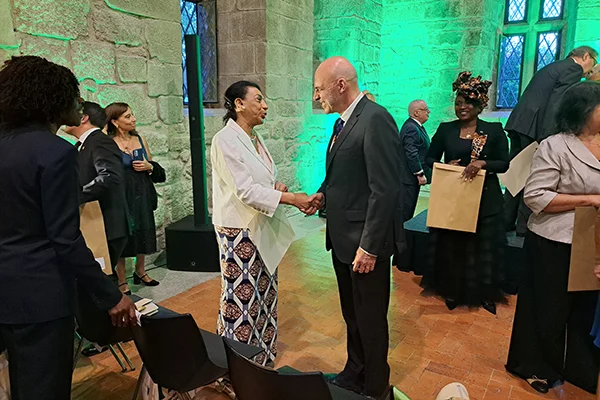
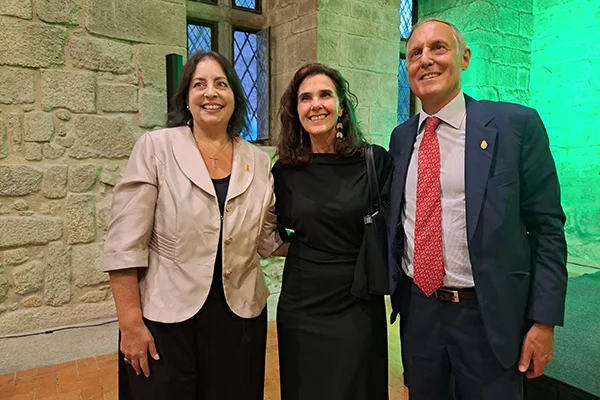
Dr. F. Álvaro Durántez Prados, director of Institutional Relations at FUNIBER, with the Angolan ambassador to Portugal, María de Jesús dos Reis Ferreira. 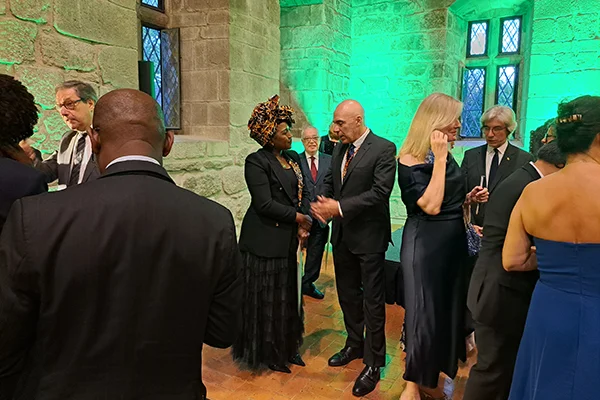
Dr. F. Álvaro Durántez Prados, Director of Institutional Relations at FUNIBER, with the Mozambican Ambassador to Portugal, Stella da Graça Magalhães Pinto Novo Zeca.
FUNIBER’s participation in this event is part of its efforts to promote cooperation and dialogue among institutions, universities, and representatives from different countries and fields. Through its international activities, the Foundation promotes spaces for interaction where education, knowledge, and culture help strengthen ties and foster greater understanding among communities and regions. FUNIBER’s presence in Guimarães thus reaffirms its commitment to building institutional bridges and developing initiatives that promote dialogue within the Iberian space and internationally.