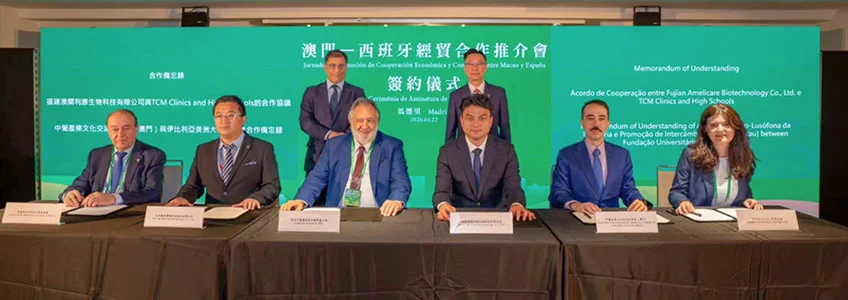
The Iberoamerican University Foundation (FUNIBER) has signed a memorandum of understanding with the Sino-Lusophone Association for Industry and the Promotion of Cultural Exchange at a ceremony held recently in Madrid, as part of the busy institutional agenda promoted by the Government of Macao in Spain.
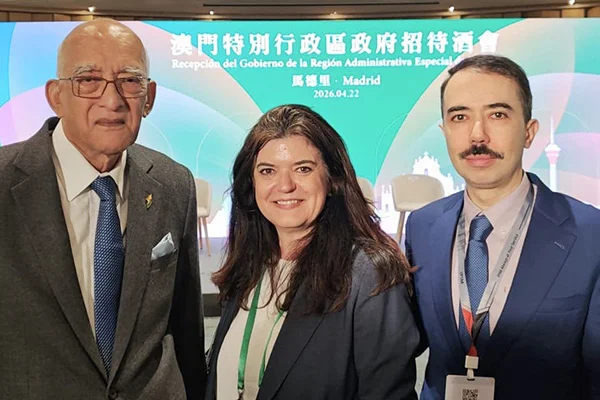
FUNIBER was represented by Dr. Mónica Gracia, the Foundation’s International Director of Admissions, and by Dong Cheng, the institution’s representative in China, who participated in this strategic event aimed at strengthening the organization’s international relations.
The signing took place within the context of the international “roadshow” organized by the Macao Government Tourism Office, an initiative that, over several days, has made Madrid the epicenter of cultural, tourism, and economic promotion for this Special Administrative Region of the People’s Republic of China. Under this strategy, Macao has rolled out an extensive program aimed at reinforcing its position as a bridge between East and West, as well as strengthening ties with Spain and the broader Spanish-speaking world.
Against this backdrop of institutional and business rapprochement, the agreement signed by FUNIBER represents a significant step in the consolidation of academic and cultural relations between the two entities. The memorandum establishes a framework for collaboration aimed at promoting joint projects in areas such as higher education, research, and the promotion of cultural exchange within the Spanish-speaking world.
Continuation of a strategy initiated in 2025
This milestone directly builds on the efforts initiated by FUNIBER in November 2025, when its Director of Institutional Relations, Dr. Frigdiano Álvaro Durántez Prados, made an institutional visit to Macau. That mission took place following the Foundation’s participation in the 7th Ibero-American and Iberophone Forum, held in Beijing and promoted by FUNIBER in collaboration with other academic and cultural institutions from China and Ibero-America.
During that visit, FUNIBER formally established its relations in Macao through meetings with academic institutions and key organizations in the territory, including the Associação Sino-Lusófona itself and the University of Macau. These meetings laid the groundwork for future collaborations, exploring Macao’s potential as a platform for connecting China and the Spanish-speaking countries.
Macau as a Platform for Interregional Coordination
Macau’s significance in this process lies in its unique historical trajectory and its role as a space where cultural traditions converge. As an enclave of Sino-Lusophone heritage, the territory has historically served as an intermediary between different regions of the world, a function that is currently reflected in its role as a platform for cooperation between China and Portuguese-speaking countries, with a growing openness toward the Spanish-speaking world.
In this context, the signing of the memorandum in Madrid takes on a dimension that transcends the strictly institutional, aligning with the internationalization strategy promoted by the Macao authorities. During the meetings held in the Spanish capital, interest was expressed in expanding cooperation in areas such as trade, cultural tourism, innovation, and the development of human capital with linguistic and cultural competencies in global settings.
Likewise, the initiative carried out in Madrid has highlighted Macao’s potential as a hub for international exchange. Through various cultural, gastronomic, and business activities, the territory has showcased its hybrid identity and its capacity to generate synergies between Asia, Europe, and Latin America, reinforcing its role as a meeting place for diverse linguistic and cultural communities.
FUNIBER’s Expansion in Asia
With the signing of this agreement, FUNIBER consolidates its position as a key player in the coordination of the Portuguese-speaking world on a global scale, while strengthening its presence in Asia. This initiative is part of a broader strategy aimed at fostering international academic cooperation, promoting the mobility of knowledge, and contributing to the construction of educational networks that respond to the challenges of an increasingly interdependent global context.
In this regard, the collaboration with the Associação Sino-Lusófona de Macao not only expands the Foundation’s geographic reach but also reinforces its role as a platform connecting different regions and cultural traditions, fostering exchange dynamics that contribute to the development of more balanced and inclusive cooperation.
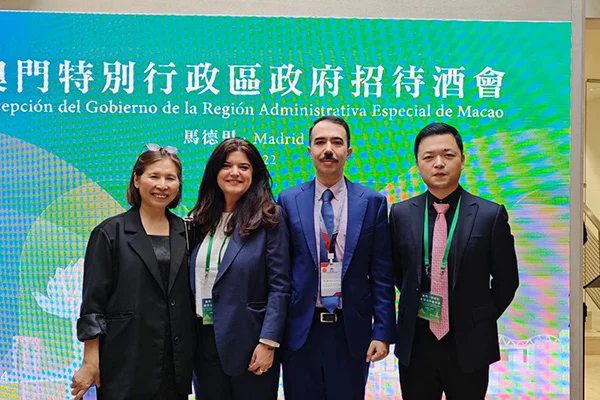
From left to right: Echo Chan, president of the Macau European Chamber of Commerce; Mónica Gracia, international director of admissions at FUNIBER; Jorge Valente, president of the Sino-Lusophone Association for Industry and the Promotion of Cultural Exchange; and Dong Chen, FUNIBER’s representative in China.